The question is no longer simply how to keep growing, but how to stay in control as you grow. How do you ensure that every location delivers the same quality, brand experience, and performance as your digital signage network becomes larger and more international?
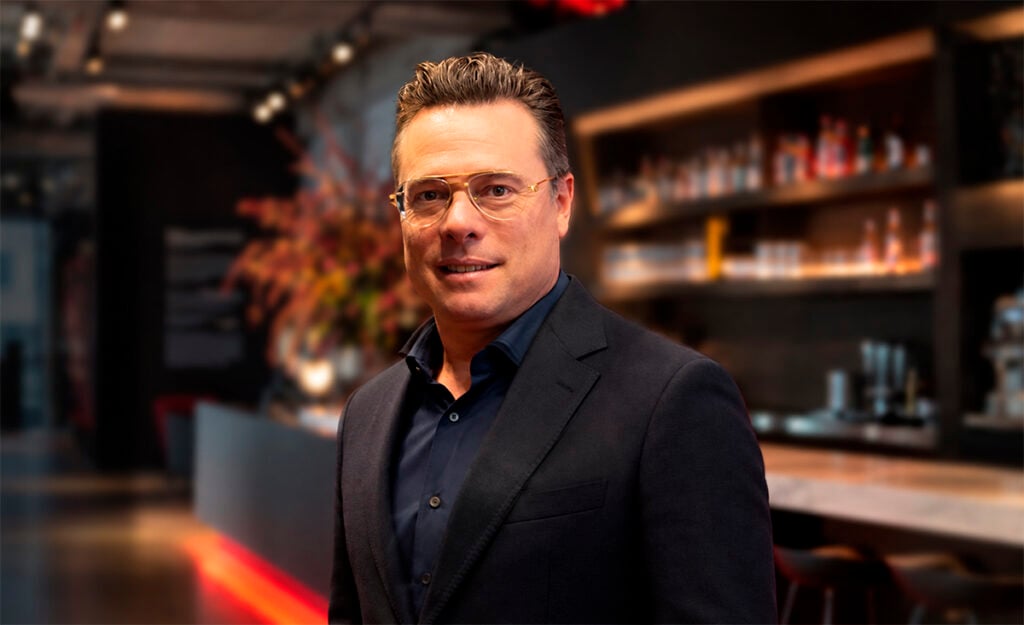
In conversation with Ron Haans, CEO of First Impression
According to Ron Haans, CEO of First Impression, global expansion is about maintaining control over quality, speed, support, costs, and brand experience as an organization grows.
That structure matters for new rollouts, where a digital signage network is built from the ground up. It is equally important for migrations, when First Impression takes over an existing network, brings greater consistency to it, and expands it further.
In this interview, Ron shares his perspective on scalability, standardization, and local flexibility. And on what it takes to build a digital signage foundation that works worldwide.
Many retailers start locally and then expand worldwide. Where do the biggest challenges arise?
“What we often see is that retailers started out working with different installation partners in different countries. At the time, that made perfect sense. A local partner is nearby and can respond quickly. But as a retailer grows, it often ends up with a patchwork of hardware, SLAs, and partners.
You may be able to manage content centrally if everything runs on a single platform, while underneath that platform, each country has different hardware, service agreements, and support channels. When something goes wrong, you have to call a different number in every country. That is when you realize global growth requires more structure, consistency, and control.
For major brands, this goes beyond technology. It is also about the brand experience. Customers expect the same level of quality and the same experience whether they are in Paris, Amsterdam, Berlin, or New York.”
“Ultimately, a rollout is about predictability”
What are retailers looking for when they want to scale worldwide?
“A successful rollout is about predictability. Knowing what happens when something goes down, knowing who is responsible, and being able to trust that the same level of quality will be delivered everywhere.
That is why documentation, standardization, and monitoring become critical. From our Network Operations Center, the NOC, we continuously monitor networks. We resolve 86% of issues remotely, and 99% are resolved within two hours. For everything else, there are clear agreements around response times, spare parts, and responsibilities.
That gives retailers peace of mind. Fewer failure costs, one point of contact, and a faster time to market. Once the foundation is right, every market does not have to reinvent the wheel.”
“You build a partner network before you need it”
What separates organizations that can successfully execute worldwide rollouts?
“Many companies only start organizing once a project begins. We believe the foundation needs to be in place before a client wants to scale worldwide.
We have invested in partner management and quality assurance for years. With a partner network spanning more than 50 countries, we can move quickly. But speed alone is not enough. Installation partners need to understand our standards, processes, and way of working.
Global standardization does not mean everything has to be exactly the same everywhere. You standardize what is needed to safeguard quality, speed, and the brand experience. Where local regulations, logistics, or market conditions require a different approach, you need to be able to adapt in a controlled way.”
“Smart Deployment makes quality transferable”

How do you prevent variations in quality when working with partners across different countries?
“That is where our Smart Deployment methodology plays an important role. One of the risks of working with partners is that quality and processes can vary from country to country. We manage that through our Smart Deployment app, which is used on site during installation.
Partners are guided step by step through installation instructions, validation points, quality checks, connectivity checks, and asset registration. That means we know how something was installed, where it is located, and whether it has been connected correctly.
It creates one approach and one consistent way of working. Applicable worldwide, while still allowing for local conditions.”
“Working worldwide requires local intelligence”
What role do local differences play in global projects?
“Every market works differently. In Australia, you have to account for vast distances, logistics planning, and availability. That requires preparation and realistic timelines.
China works differently. You cannot always plan everything far in advance, but if you need someone quickly and ask the right question, a lot can be arranged in a very short time. In North America, we have also learned just how important clear expectations and rigorous monitoring are.
The standard needs to be clear. The quality needs to be right. How you get there can adapt to the market.”
“The rollout is only the beginning”

When do you consider a global rollout truly successful?
“Of course, you want to deliver on time and on budget. Ultimately, you also want a network that operates at 99.9% uptime. But there is something else that matters to me: at the end of the project, is everyone smiling?
With major global rollouts, there will always be hiccups. The difference lies in how you solve them together. And in many ways, that is when the real work begins. Lifecycle management, expansion, and innovation come next. That is when the relationship starts shifting from supplier to partner.
The best partnerships are the ones where you work together for years and keep asking what the next step should be.”
Global growth requires a scalable foundation
The larger a retailer becomes, the more important it is for systems, processes, and support to operate from the same foundation everywhere. For Pandora, for example, First Impression is involved as the lead contractor within a broader store project where digital signage, window concepts, fixtures, and local execution come together.
It is precisely this combination of global consistency and strong local execution that makes a digital signage network scalable for the long term. For retailers, that means fewer failure costs, one point of contact, faster time to market, and a brand experience that feels consistent around the world.
Curious how First Impression supports global retail rollouts? Explore our approach.